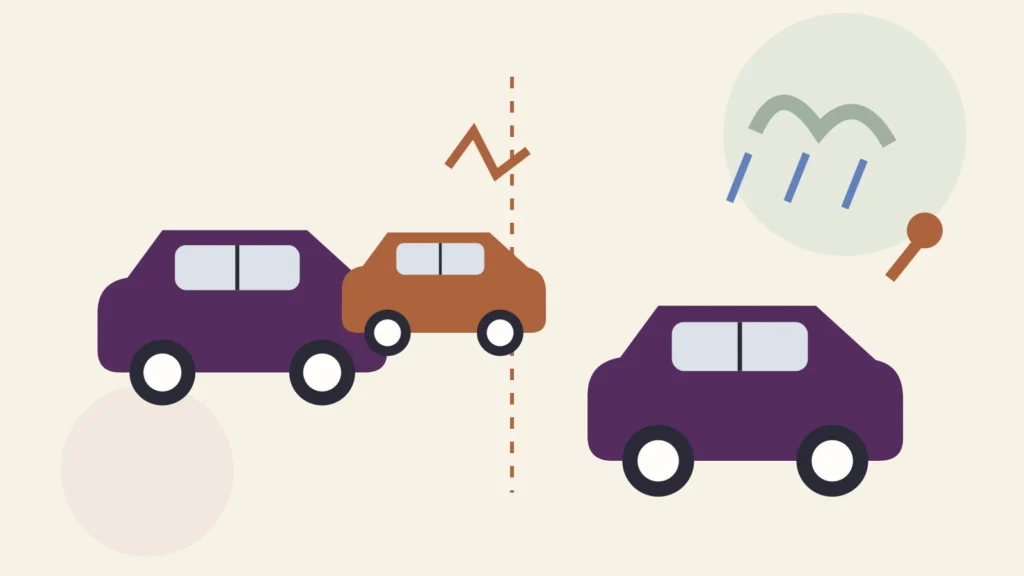
An auto insurance policy is not one single thing. It’s a bundle of separate coverages, each priced and triggered differently, and each answering a different question about who pays for what after an accident.
Some of those coverages are required by your state’s law. Others are required only if you have an auto loan or lease. The rest are optional add-ons you choose based on your own situation. This guide walks through each type in plain language, so you can look at your own declarations page and understand exactly what you’re paying for.
Legally required coverage: liability insurance
Most states require drivers to carry some form of liability insurance before registering a vehicle. Liability insurance has two components, and it’s worth separating them clearly because they answer different questions.
Bodily injury liability applies when the policyholder causes an accident that injures someone else — another driver, a passenger, or a pedestrian. It does not pay for the policyholder’s own injuries. It pays, up to the policy’s limit, for the other person’s medical costs, lost income, and related damages, and it also generally pays for a legal defense if the policyholder is sued over the accident.
Property damage liability applies when the policyholder damages someone else’s property — typically another vehicle, but also fences, mailboxes, or storefronts. Like bodily injury liability, it only covers damage the policyholder causes to others, not damage to the policyholder’s own car.
Both coverages are usually required by state law, but the required minimum dollar amounts are set individually by each state and differ significantly. For a full explanation of how those limits are structured and a few state-specific examples, see how auto insurance liability limits work.
Important limitation
State-required minimum liability limits are a legal floor, not a safety recommendation. Multiple official consumer guides note that minimum limits are frequently too low to fully cover a serious accident, and a policyholder can be personally responsible for any judgment above their policy’s limit.
Coverage your lender may require
If a vehicle is financed or leased, the lender or lessor typically requires two additional coverages as a condition of the loan, regardless of what state law requires:
- Collision coverage — pays to repair or replace the insured vehicle after it collides with another car, an object, or overturns.
- Comprehensive coverage — pays for damage to the insured vehicle from causes other than a collision, such as theft, fire, hail, flood, vandalism, or hitting an animal.
Lenders require these because the vehicle is their collateral; they want assurance it’s covered until the loan is paid off. Both coverages usually carry a separate deductible, and both typically pay out based on the vehicle’s actual cash value rather than the cost of full replacement — an important distinction covered in more depth in Collision vs. Comprehensive Insurance: What Each Coverage Pays For.
Fictional example (for illustration only): A driver named "Maria" finances a car through a credit union. Her loan agreement requires comprehensive and collision coverage with a maximum $1,000 deductible on each, for as long as the loan is outstanding. This requirement comes from her lender’s contract, not from her state’s insurance law — a distinction worth understanding before assuming any coverage is "required" everywhere.
Coverage that protects you and your passengers
A few coverages exist specifically to pay for the policyholder’s own injuries or the injuries of passengers, separate from what liability insurance does for other people:
- Medical payments coverage (MedPay) — pays medical and sometimes funeral expenses for the policyholder and passengers, regardless of who caused the accident, up to the policy’s limit.
- Personal injury protection (PIP) — can cover medical expenses and, depending on state law and policy terms, items such as lost income or funeral expenses for eligible insured people, generally without first deciding fault. PIP is central to many no-fault systems, but some at-fault states also require insurers to provide or offer it. Texas, for example, requires PIP to be provided unless the named insured rejects it in writing. Availability, required limits, benefits, and claim procedures therefore depend on the state and policy.
- Uninsured motorist coverage and underinsured motorist coverage — pay when the at-fault driver has no insurance, or not enough insurance, to cover the policyholder’s damages.
Because UM/UIM rules differ substantially by state — including whether the coverage is mandatory, whether it can be rejected in writing, and whether it can be "stacked" across multiple vehicles — this topic gets its own full explanation in Uninsured and Underinsured Motorist Coverage Explained.
Optional convenience coverages
None of the following are required by law or by most lenders. They’re priced separately, and whether to add them is a personal decision based on cost and circumstance:
- Rental reimbursement — pays a limited daily amount toward a rental car while the insured vehicle is being repaired after a covered comprehensive or collision claim. It typically has both a daily dollar cap and a maximum number of days.
- Roadside assistance / towing coverage — reimburses costs like towing to a repair shop, a lockout, or a jump-start when a vehicle is disabled.
- Guaranteed Asset Protection (GAP) — may cover some or all of the difference between a vehicle’s covered total-loss value and the qualifying balance still owed on a loan or lease. Contract caps, excluded balances, eligibility rules, cancellation terms, and the treatment of items rolled into financing vary, so GAP should not be described as an automatic payoff of every remaining amount.
These add-ons do not all use the same trigger. Rental reimbursement is commonly tied to a covered physical-damage loss; GAP generally depends on a qualifying covered total loss and its own contract terms; roadside assistance responds to listed service events such as towing or lockout assistance. Each coverage has its own limits, conditions, and exclusions.
How limits and deductibles interact
Every coverage on an auto policy has a policy limit — the maximum the insurer will pay for a covered loss — and physical-damage coverages (collision, comprehensive) also carry a deductible, the amount the policyholder pays out of pocket before the insurer pays the rest.
Liability coverage limits are commonly expressed as three numbers, such as 25/50/15 — a format sometimes called a split limit. The full mechanics of how that works, including a state-by-state caution about relying on any single nationwide chart, are covered in How Auto Insurance Liability Limits Work.
Reading your own declarations page
The only reliable way to know what coverage you actually carry — and at what limits — is to review your own declarations page. When reviewing it, look for:
- Each coverage type listed separately (bodily injury liability, property damage liability, collision, comprehensive, UM/UIM, MedPay or PIP, and any optional add-ons)
- The dollar limit attached to each coverage
- The deductible attached to collision and comprehensive
- Whether rental reimbursement, roadside assistance, or GAP appear at all — if they’re not listed, they’re not part of the policy
For a full walkthrough of every section of a declarations page, see How to Read an Insurance Declarations Page.
Common misunderstandings
Misunderstanding: "Full coverage" is an official insurance term that means a policy covers everything.
More accurate: "Full coverage" is informal shorthand, usually meaning a policy that includes liability plus collision and comprehensive. It is not a legal or contractual term, and it does not mean unlimited protection — every coverage still has its own limit and its own list of exclusions.
Misunderstanding: If a vehicle is paid off, none of these coverages matter anymore.
More accurate: Liability coverage requirements under state law do not depend on whether a vehicle is financed. Only the lender-driven requirement for collision and comprehensive goes away once a loan is paid off; whether to keep those coverages voluntarily is then the owner’s choice, based on the vehicle’s value and their own risk tolerance.
Misunderstanding: Comprehensive coverage means "comprehensive" in the everyday sense — that it covers everything.
More accurate: Comprehensive coverage has a specific, narrower meaning: it covers non-collision damage to the insured vehicle. It does not cover the driver’s own injuries, does not cover damage the driver causes to someone else, and does not cover mechanical breakdowns unrelated to a covered peril.
FAQ
Is comprehensive or collision coverage required by law?
Generally, no. Most states require liability coverage but do not require comprehensive or collision. Those two coverages are typically required by a lender or lessor instead, as a condition of financing.
Does auto insurance cover my own medical bills if I cause an accident?
Liability insurance does not; it pays for the other party’s injuries. The policyholder’s own medical costs would typically be handled through MedPay, PIP (where available), health insurance, or out of pocket, depending on the state and the policy.
Does gap insurance replace the need for collision or comprehensive coverage?
No. GAP coverage only pays the difference between a vehicle’s actual cash value and the remaining loan or lease balance after a covered total loss under comprehensive or collision coverage. It does not function as a standalone physical-damage coverage.
Important limitations
This article provides general educational information about how U.S. auto insurance coverages are typically structured. It is not personalized insurance, legal, or financial advice, and it does not describe every insurer’s policy language. Coverage names, definitions, availability, and required minimums vary by state and by insurer, and can change after this article’s review date. Always confirm current requirements with your state department of insurance and the specific terms of your own policy.
Official sources
- NAIC: What Does Auto Insurance Cover?
- NAIC: Auto Insurance topic overview
- NAIC: Consumer Auto Insurance overview
- Texas Department of Insurance: Personal auto filing requirements
- California Department of Insurance: Automobile Insurance guide
Conclusion
Auto insurance is easiest to understand once you stop thinking of it as one product and start seeing it as a set of separate answers to separate questions: what happens if you hurt someone else, what happens if your own car is damaged, and what conveniences you’ve chosen to pay extra for. The clearest way to see which of these apply to you is to sit down with your own declarations page. If you want to go deeper on any single piece — how collision differs from comprehensive, how uninsured motorist coverage works, or how liability limits are structured — the related guides above cover each in detail.