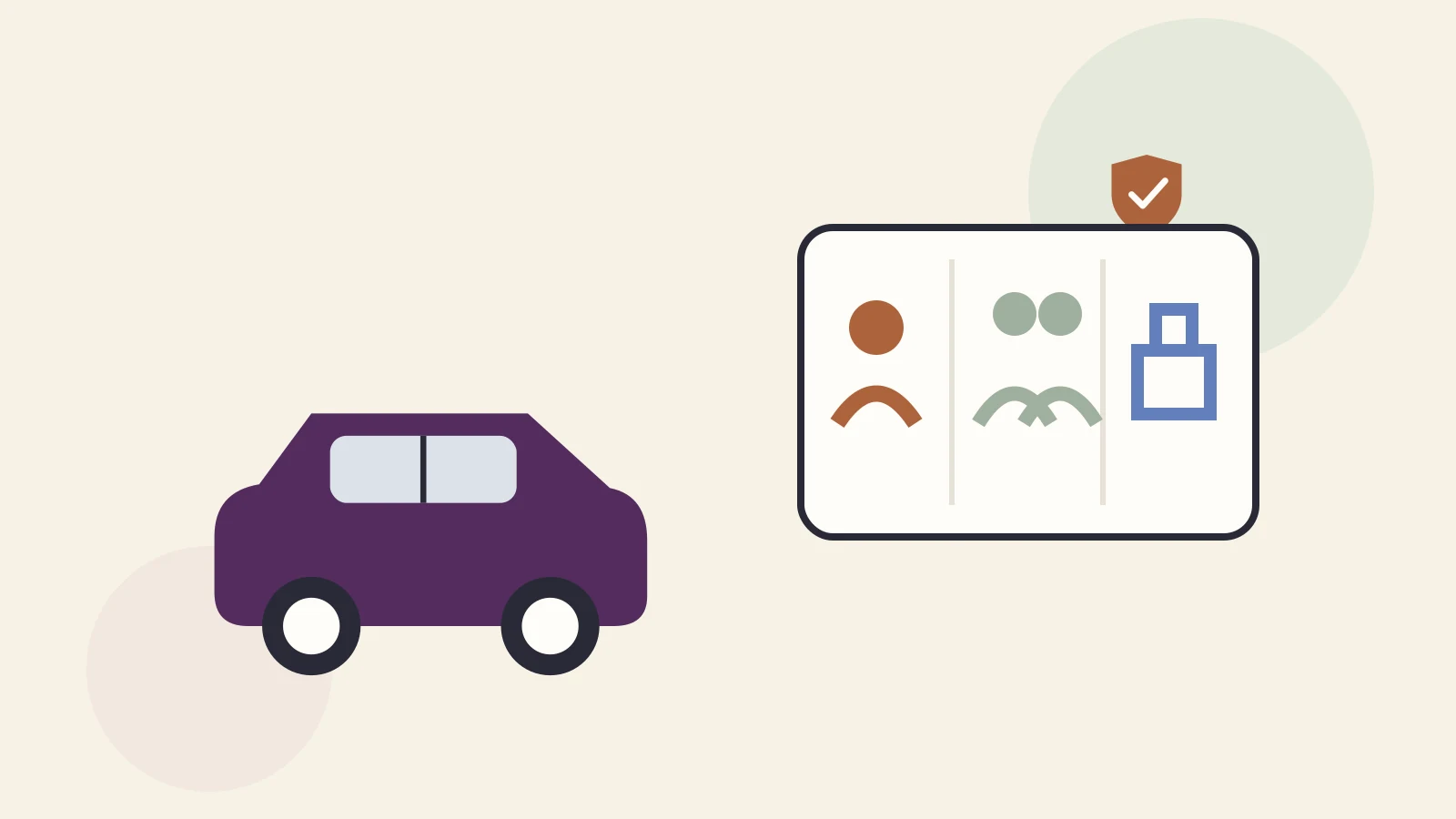
25/50/25 means three separate auto-liability caps: $25,000 of bodily-injury liability for any one injured person, $50,000 total bodily-injury liability for one accident, and $25,000 of property-damage liability for that accident. The numbers are separate ceilings, not one interchangeable pool, and they do not guarantee a particular claim payment. This guide explains how split limits, per-person and per-accident caps, combined single limits, and state minimums fit together without recommending a specific amount of coverage.
What 25/50/25 Means: Three Auto Liability Limits
A split-limit liability policy is usually written as three numbers separated by slashes — for example, 25/50/25. According to official consumer guidance, each number answers a distinct question:
- First number — per-person bodily injury limit. The most the policy will pay for injuries to any one person in an accident the policyholder caused.
- Second number — per-accident bodily injury limit. The most the policy will pay, in total, for injuries to everyone injured in that same accident — regardless of how many people that is, subject to the per-person limit for each individual.
- Third number — per-accident property damage limit. The most the policy will pay for damage the policyholder causes to other people’s property in that accident, again regardless of how many vehicles or objects are damaged.
A labeled breakdown, using 25/50/25 as an illustrative example only (not a recommendation and not any specific state’s requirement):
- $25,000 — maximum paid to any one injured person
- $50,000 — maximum paid in total to all injured people in that one accident
- $25,000 — maximum paid for all property damage in that one accident
Fictional example (for illustration only): "Alicia" causes an accident injuring two people and damaging one other vehicle. Her policy carries 25/50/25 limits. If one injured person’s damages come to $30,000 and the other’s come to $15,000, the first person’s recovery from Alicia’s policy is capped at $25,000 (the per-person limit) even though the per-accident limit of $50,000 hasn’t been fully used — because no single person’s claim can exceed the per-person number. The remaining $5,000 gap for that person, if not otherwise resolved, could become Alicia’s personal financial responsibility. This example is illustrative only.
Per-person versus per-accident: why both numbers matter
The per-person and per-accident numbers work together, not independently. The per-accident number is not simply "extra" money available to any one claimant — it’s a shared ceiling across everyone injured in that one accident, while the per-person number caps what any single individual can recover regardless of how much of the per-accident total remains unused.
This distinction becomes especially important in accidents involving multiple injured people, where the per-accident limit can be reached well before every individual claim is fully paid — leaving some claimants under-compensated by the at-fault driver’s policy even though the policy technically "had more room" on paper.
Combined single limit: a different structure
Some policies — more common on commercial or umbrella-adjacent coverage than on standard personal auto policies — use a combined single limit (CSL) instead of a split limit. A combined single limit sets one aggregate dollar figure that applies to both bodily injury and property damage together, per accident, without separating out a per-person sub-limit.
A combined single limit can offer more flexibility in accidents with an unusual mix of injury and property damage, since the full limit is available for either type of loss rather than being divided in advance. Whether a specific policy uses a split limit or a combined single limit is stated on the declarations page, and this is a structural choice made when the policy is written — not something this article recommends one way or the other.
For a broader explanation of per-person, per-occurrence, aggregate, and sublimit structures across insurance policies, see Insurance Policy Limits Explained.
State minimums are a legal floor, not a recommendation
Every state that requires liability insurance sets its own minimum dollar limits, and — as official consumer guidance repeatedly emphasizes — those minimums exist to satisfy a legal requirement, not to represent an adequate amount of protection for a serious accident. A few statute-verified examples illustrate both how these minimums are structured and how much they can vary:
- California requires minimum liability limits of $30,000 per person / $60,000 per accident for bodily injury, and $15,000 per accident for property damage, for policies issued or renewed on or after January 1, 2025 — an increase from the prior $15,000/$30,000/$5,000 minimums that had been in place for decades (Cal. Vehicle Code § 16056; Cal. Ins. Code § 11580.1(b); California Department of Insurance Bulletin 2023-1).
- Texas requires minimum liability limits of $30,000 per person / $60,000 per accident for bodily injury, and $25,000 per accident for property damage, effective since January 1, 2011 (Tex. Transp. Code § 601.072).
- Virginia raised its minimum liability limits to $50,000 per person / $100,000 per accident for bodily injury, and $25,000 per accident for property damage, for policies effective on or after January 1, 2025 — up from $30,000/$60,000/$20,000 previously (Virginia DMV, insurance requirements page).
- Louisiana requires minimum liability limits of $15,000 per person / $30,000 per accident for bodily injury, and $25,000 per accident for property damage (Louisiana Department of Insurance consumer guide).
These four examples show meaningful variation among states. They were checked against official sources on July 31, 2026, but no figure in this article should be treated as another state’s current requirement. Confirm the law in force for the policy date with the relevant state insurance department, DMV, or legislature.
Why minimums are not a recommendation
State minimum liability limits are compliance thresholds, not individualized coverage recommendations. A serious accident can produce covered damages above a minimum limit, but this guide does not prescribe a dollar amount. Any evaluation should use the reader’s current declarations page, assets and obligations, available policy options, and applicable state law rather than a universal number.
What happens if a judgment exceeds the policy limit
If a policyholder is found legally responsible for damages that exceed their liability policy’s limit, the insurer’s payment obligation generally stops at that limit. Depending on state law and the specifics of the case, the policyholder can become personally responsible for the remaining amount, which a court judgment could pursue through the policyholder’s other assets or future income. This is one reason official guidance frames minimum limits as a floor rather than a ceiling worth relying on.
A liability policy may include a duty to defend a covered lawsuit, but the scope of that duty, selected counsel, supplementary payments, and whether any expenses reduce an available limit depend on the policy form and state law. The declarations page alone may not answer this question; the liability insuring agreement, defense provisions, and endorsements should be reviewed.
Where umbrella coverage fits — as a concept only
Some policyholders add a personal umbrella policy on top of their auto (and often homeowners) liability limits, to provide an additional layer of coverage once the underlying auto policy’s limit is exhausted. This article mentions umbrella coverage only as a neutral concept that exists in the market — it does not recommend an umbrella policy, a specific umbrella limit, or that any particular reader needs one. For a related discussion of liability limits in a different context, see Personal Liability Coverage in Homeowners Insurance.
Reviewing your own declarations page
To see your current liability limit structure, check your declarations page for:
- Whether your policy shows a split limit (three numbers) or a combined single limit (one number)
- The specific dollar figures attached to bodily injury and property damage
- Whether your UM/UIM limits match your liability limits or differ from them — see Uninsured and Underinsured Motorist Coverage Explained for why that comparison matters
- The effective date of your policy, since minimums and available limit options can change at renewal
For a full walkthrough of every section of a declarations page, see How to Read an Insurance Declarations Page.
Common misunderstandings
Misunderstanding: The per-accident number means each injured person can receive that full amount.
More accurate: The per-accident number is a shared ceiling across everyone injured in that accident; no individual claimant can exceed the per-person number, and the per-accident total isn’t simply multiplied by the number of people involved.
Misunderstanding: Buying the state minimum means you’re "covered" in any accident.
More accurate: The state minimum satisfies the legal requirement to drive, but official guidance is consistent that it’s frequently insufficient for a serious accident, leaving the policyholder personally exposed for anything above the limit.
Misunderstanding: A combined single limit is always a bigger number than a split limit, so it’s automatically better.
More accurate: A combined single limit restructures how the same overall protection is allocated between bodily injury and property damage; it isn’t automatically higher or lower than an equivalent split-limit policy, and comparing the two requires looking at the actual dollar figures involved.
FAQ
What does 100/300/100 mean on an insurance policy?
Using the same three-number format described above, this would mean $100,000 maximum per injured person, $300,000 maximum total per accident for bodily injury, and $100,000 maximum per accident for property damage. This is presented as a format example only, not a recommendation.
Can I choose a combined single limit instead of a split limit?
Availability depends on your insurer and, in some cases, your state. Not every insurer offers both structures on personal auto policies. Ask your agent or insurer what structures are available to you.
Does a higher liability limit always cost a predictable amount more?
No general price relationship can be stated reliably. Pricing varies by insurer, state, vehicle, drivers, rating factors, and the limits selected. Comparable quotes using the same assumptions are needed to evaluate an actual price difference.
Important limitations
This article explains the general structure of split-limit and combined-single-limit liability coverage and provides a small number of statute-verified state minimum examples for illustration. It is not a nationwide table of current state minimums, is not personalized insurance, legal, or financial advice, and does not recommend any specific liability limit. State minimums change periodically — always verify your own state’s current requirement with your state department of insurance or DMV, and review your own policy’s declarations page for your actual coverage.
Official sources
- NAIC: Auto Insurance topic overview
- California Department of Insurance: Automobile Insurance guide
- Texas Department of Insurance: Minimum liability overview
- Virginia DMV: Insurance requirements
- Louisiana Revised Statute 32:900
Conclusion
Once you can read a split limit as three separate answers — who, how many, and what property — the numbers on a declarations page stop being a mystery. The harder question, how much coverage is actually enough, isn’t one this guide answers, because it depends on personal circumstances a general article can’t evaluate. What it can do is point you toward the next related pieces of the picture: how uninsured and underinsured motorist coverage interacts with your liability limits, and what happens procedurally if you ever need to file a claim.