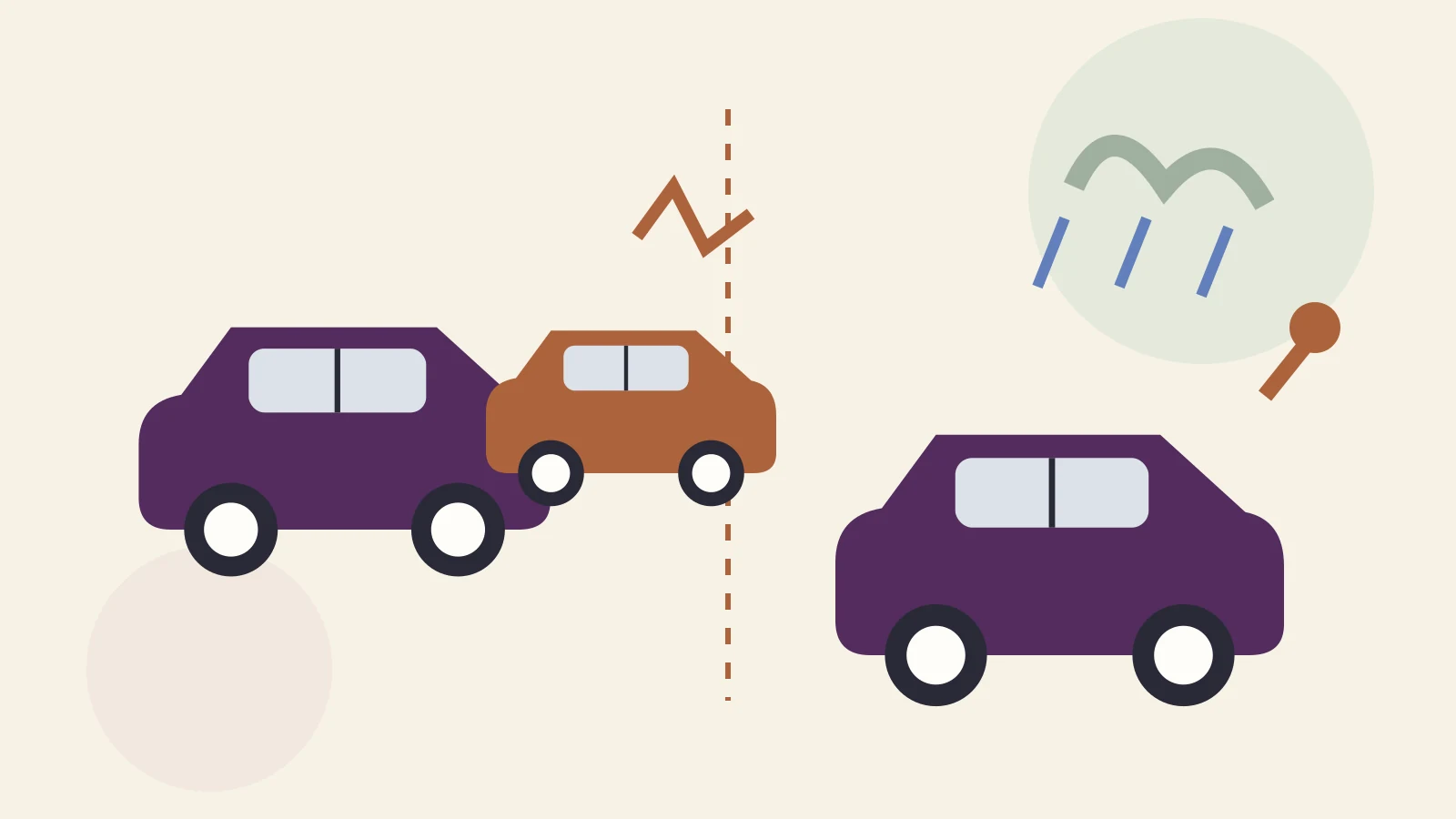
Quick answer: Collision coverage generally pays for covered damage to your car after a crash with another vehicle or object, a pothole impact, or a rollover. Comprehensive coverage—often called “other than collision”—generally covers non-collision losses such as theft, fire, vandalism, hail, flood, falling objects, glass damage, and animal strikes, subject to the policy.
Both coverages commonly have separate deductibles. State law generally does not require collision or comprehensive, but a lender or lessor may require both on a financed or leased vehicle. Check your declarations page for the coverages and deductibles on your own policy, and use the broader auto insurance coverage guide to see how they fit alongside liability and other coverages.
What collision coverage responds to
Collision coverage pays for damage to the insured vehicle caused by colliding with something. According to official consumer guidance, this includes:
- A crash with another vehicle, regardless of who was at fault
- Hitting a fixed object, such as a guardrail, pole, or fence
- Hitting a pothole
- A single-vehicle rollover
Because collision coverage applies "regardless of who was at fault" for damage to the insured vehicle, a policyholder can typically file a collision claim even in a single-car accident, or even when they caused the crash themselves. The tradeoff is the deductible: the policyholder pays that amount out of pocket before the insurer covers the rest.
Fictional example (for illustration only): "Devon" is driving on a rural road at night and swerves to avoid debris, sliding off the shoulder and striking a fence post. No other vehicle is involved. Because this is a collision with a fixed object, it would typically be evaluated under Devon’s collision coverage, not comprehensive — subject to Devon’s own policy wording and deductible.
What comprehensive coverage responds to
Comprehensive coverage — sometimes labeled "other than collision" on a declarations page — pays for damage to the insured vehicle from causes that are not a collision. Based on official consumer guidance, this typically includes:
- Theft of the vehicle or parts of it
- Fire
- Vandalism
- Hail, windstorm, and certain flood damage
- Falling objects (a tree limb, for example)
- Hitting an animal, such as a deer
Comprehensive coverage generally also extends to glass damage, such as a cracked or pitted windshield, though — as covered below — a small number of states add their own rules on top of the standard policy language for glass claims specifically.
Fictional example (for illustration only): "Priya" parks her car overnight and wakes up to find a tree branch has fallen on the hood during a storm. Because no collision occurred — nothing struck the car through impact with another vehicle or object under her control — this would typically fall under comprehensive coverage, subject to her policy’s terms and deductible.
Side-by-side: which coverage applies to common events
Rather than a wide comparison table, here is a stacked breakdown of common events and which coverage they typically fall under. Because policy wording varies by insurer, always confirm the specific treatment of an event against your own policy booklet.
Typically collision:
- Rear-ending another car, or being rear-ended
- Hitting a parked car
- Striking a guardrail or curb
- A single-car rollover
- Hitting a pothole
Typically comprehensive:
- Car theft (whole vehicle or parts)
- Vandalism
- Hail or windstorm damage
- Flood damage
- Fire (not caused by a collision)
- Hitting a deer or other animal
- A cracked windshield from road debris
Frequently a gray area, requiring adjuster review:
- A hit-and-run where the other vehicle is never identified (often reviewed under uninsured motorist property damage where that coverage exists, or under collision, depending on the policy and state — see Uninsured and Underinsured Motorist Coverage Explained)
- Damage from a falling object that also involves the vehicle rolling or sliding into something else
Deductibles and actual cash value
Both collision and comprehensive coverage typically carry their own separate deductible — the amount the policyholder pays before the insurer pays the rest of a covered claim. It’s common for a policy to have a different deductible for each: for example, a $500 collision deductible and a $250 comprehensive deductible, or vice versa.
Both coverages also commonly value a covered total loss using the vehicle’s actual cash value, rather than the price of a brand-new replacement. Whether a damaged vehicle is treated as a total loss can depend on repair estimates, salvage value, state total-loss rules, and the insurer’s approved valuation process—not one nationwide repair-cost formula. The distinction between actual cash value and replacement cost is explained more fully in Actual Cash Value vs. Replacement Cost.
Important limitation
Neither collision nor comprehensive coverage guarantees full replacement of a totaled vehicle. Both are subject to the vehicle’s actual cash value, the applicable deductible, and any exclusions in the specific policy. A vehicle’s cash value can be lower than what an owner still owes on a loan — which is the specific gap that gap coverage is designed to address, not collision or comprehensive coverage itself.
Where lender requirements come in
If a vehicle is financed or leased, the lender or lessor commonly requires both collision and comprehensive coverage for as long as the loan or lease is active, because the vehicle serves as their collateral. This is a private contractual requirement from the lender, separate from any state insurance law. Once a loan is paid off, the requirement to carry these coverages generally ends, and continuing them becomes the owner’s own choice.
A state-specific example: glass deductible waivers
Most states treat windshield and glass damage as an ordinary comprehensive claim, subject to the policy’s normal comprehensive deductible. A small number of states have added their own statutory rule on top of that general framework:
- Florida law waives the comprehensive deductible specifically for windshield damage (Fla. Stat. § 627.7288).
- Kentucky law waives the comprehensive deductible for a broader category of "motor vehicle glass," including windshield, door, and window glass (KRS § 304.20-060).
- South Carolina law waives the comprehensive deductible for "safety glass" claims — generally windshield, side, and rear windows — when comprehensive coverage is carried (S.C. Code § 38-77-280(B)).
These are verified examples as of September 18, 2026—not a complete national list. Other states may use different mandates, repair-versus-replacement rules, or optional glass endorsements. South Carolina legislation considered during 2026 also illustrates why the effective date matters: readers should verify the law in force when a loss occurs or a policy renews. The broader lesson is that state law and policy wording are separate layers and both should be checked.
When both coverages exist on the same policy
It’s standard for a single auto policy to carry both collision and comprehensive together, since between them they cover most of the ways a vehicle can be damaged short of normal wear. It’s also possible to carry only one — for example, some owners of older, low-value vehicles choose to drop collision (the more expensive of the two) while keeping comprehensive for lower-cost risks like theft or weather, or drop both once a vehicle is paid off and its value no longer justifies the premium. Whether that trade-off makes sense for a specific vehicle depends on its market value, the cost of the coverage, and the owner’s own financial circumstances — a decision this guide does not make on the reader’s behalf.
Common misunderstandings
Misunderstanding: Hitting a deer is a collision claim because a collision occurred.
More accurate: Despite the physical impact, official consumer guidance from multiple state insurance departments classifies hitting an animal as a comprehensive claim, not a collision claim. This is a naming convention specific to insurance policies, not a description of physical events.
Misunderstanding: If comprehensive covers "almost everything else," it must also cover mechanical breakdowns.
More accurate: Comprehensive coverage responds to sudden, accidental, non-collision events like theft or weather. It does not generally cover routine mechanical failure, wear and tear, or maintenance issues, which fall outside both collision and comprehensive.
Misunderstanding: Collision and comprehensive pay to replace a car with a brand-new equivalent model.
More accurate: Both typically pay based on the vehicle’s actual cash value at the time of loss — which factors in age, mileage, and condition — not the cost of a new replacement vehicle, unless a separate new-car-replacement endorsement has been added.
FAQ
Does comprehensive coverage have its own deductible for glass claims, even in Florida, Kentucky, or South Carolina?
For the Florida, Kentucky, and South Carolina examples described above, the cited law controls the eligible glass category and effective period. The waiver does not convert every comprehensive loss into a zero-deductible claim, and readers should confirm the current statute and policy wording before relying on it.
If someone keys my car in a parking lot, is that collision or comprehensive?
Vandalism is typically treated as a comprehensive event under official consumer guidance, since it does not involve a collision.
Does collision coverage apply if I hit my own garage door?
This is generally evaluated as a collision claim, since it involves the insured vehicle colliding with an object, though the specific treatment depends on the policyholder’s own policy wording.
Important limitations
This article explains typical, general distinctions between collision and comprehensive coverage based on official consumer guidance and, for glass claims, specific state statutes. It does not describe every insurer’s exact policy language, does not constitute personalized insurance advice, and does not recommend whether any individual reader should carry, drop, or adjust either coverage. Always review your own policy documents and consult your insurer or agent for how a specific event would be handled under your specific policy.
Official sources
- NAIC: What Does Auto Insurance Cover?
- NAIC: Consumer Auto Insurance overview
- Florida Statute § 627.7288: windshield deductible
- Kentucky Revised Statute § 304.20-060
- South Carolina Code § 38-77-280
- South Carolina 2025–2026 Bill 4817 status and text
Conclusion
Once you separate an impact loss from a listed non-collision event, the distinction becomes easier: collision commonly responds to crashes and rollovers, while comprehensive commonly responds to covered causes such as theft, weather, fire, vandalism, glass damage, or animal strikes. Neither phrase overrides the policy’s definitions and exclusions. From here, the natural next question for most drivers is how much liability coverage sits alongside these physical-damage coverages, which is covered in How Auto Insurance Liability Limits Work, or what happens procedurally once any of these claims is filed, which is covered in What Happens After Filing an Auto Insurance Claim.