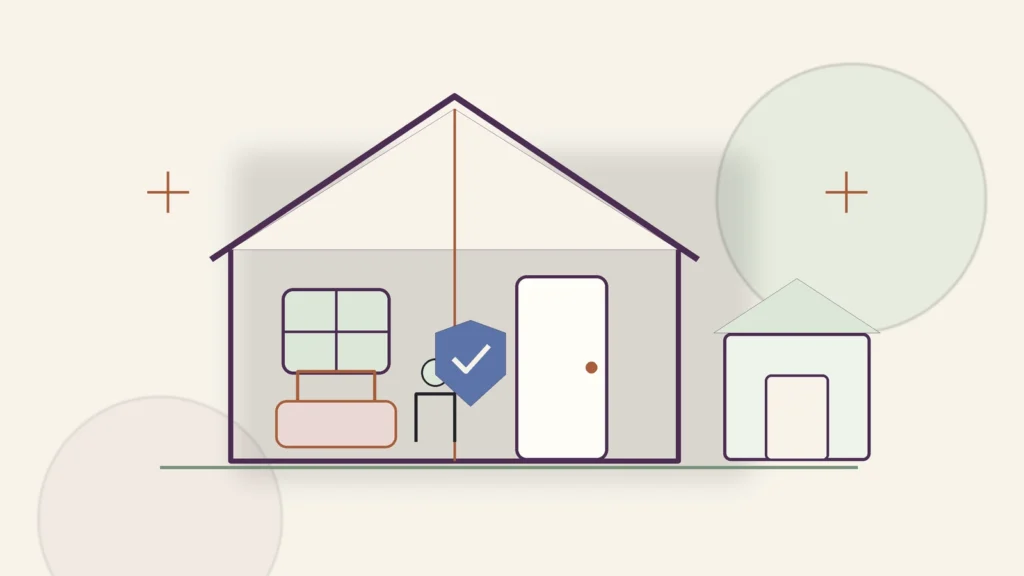
If you rent your home, your landlord’s insurance protects the building — not what’s inside it. That distinction is the entire reason renters insurance exists.
A typical renters policy bundles a small number of coverages that answer very different questions: what happens to your belongings, what happens if someone else is hurt in your home, and where you’d stay if your rental became unlivable.
Why your landlord’s policy doesn’t protect your belongings
According to NAIC consumer guidance, a landlord’s or property manager’s insurance policy generally does not cover a tenant’s personal belongings if they’re damaged or stolen. The landlord’s coverage is designed to protect the building structure they own — not the furniture, electronics, or clothing that belong to the people living inside it.
This is the same basic property/liability structure found in a homeowners policy, just scaled down to what a renter actually owns and is responsible for. If you want the fuller six-coverage picture that a property owner carries, What Does Homeowners Insurance Cover? explains it in detail — renters insurance covers a similar but narrower slice of that same structure.
The coverages a renters policy typically includes
Personal property. This pays to repair or replace your belongings — furniture, electronics, clothing, and similar items — if they’re damaged, destroyed, or stolen by a covered cause of loss. Depending on your policy, this may follow your belongings outside the home too, subject to limits.
Personal liability. This protects you financially if you’re found legally responsible for someone else’s injury or property damage, and covers legal defense costs along with any damages awarded, up to your policy limit.
Medical payments to others. A smaller coverage that may pay limited medical costs when someone is accidentally injured, without first requiring a finding that you were legally liable, subject to the policy’s terms and exclusions.
Loss of use (additional living expenses). If a covered loss makes your rental temporarily unlivable, this helps pay the extra cost of living elsewhere — it generally pays only the difference between your normal living costs and your temporary ones, not your entire temporary rent or hotel bill.
Named peril vs. open peril policies
A commonly cited distinction, described directly by Colorado’s Division of Insurance, is between two ways a policy can define what’s covered:
- A named-peril policy covers only the specific causes of loss it lists — commonly things like fire, smoke, theft, vandalism, and certain water damage. Under this type, you generally have to show that a listed peril caused your loss.
- An open-peril (sometimes called “all-risk” or “comprehensive”) policy covers any cause of loss except what’s specifically excluded, and generally costs more. Under this type, the burden is on the insurer to show an exclusion applies.
NAIC consumer guidance describes the broad or named-peril form as a commonly purchased renters-policy structure, while broader forms may cover causes of loss unless excluded. Product availability and terminology vary, so your policy’s insuring agreement and exclusions control.
What renters insurance typically does not cover
Flood damage is a common gap. Standard renters policies typically exclude flooding, so a renter who wants contents coverage for flood may need a separate flood policy through the National Flood Insurance Program or a private insurer, subject to availability and policy terms.
High-value items like fine jewelry, art, or musical instruments often carry smaller built-in sub-limits under standard personal property coverage. If you own something valuable in one of these categories, a scheduled endorsement (sometimes called a floater) may be worth understanding — this is covered in more detail in What Is an Insurance Endorsement?
Roommates and shared living situations
A common point of confusion involves unrelated roommates. Louisiana’s Department of Insurance notes that roommates may sometimes be named on one policy or may each buy separate coverage, but eligibility and claim mechanics depend on the insurer and the issued contract.
There isn’t one universally “correct” approach — it depends on your relationship with your roommates, how you’d want a claim handled, and what your specific insurer allows. A few things worth understanding before deciding:
- An unrelated roommate who is not an insured under the policy should not assume that the policy covers their belongings or liability.
- If an insurer permits a shared policy, confirm whether limits apply to the policy as a whole and how a loss involving more than one roommate would be handled.
- Insurer eligibility rules for adding an unrelated roommate to a single policy vary by company.
A fictional example, for illustration only
Consider a hypothetical renter, “Jordan,” who shares a two-bedroom apartment with a roommate. Jordan carries an individual renters policy with $20,000 in personal property coverage and a $500 deductible. A kitchen fire, entirely fictional, damages $3,000 of Jordan’s own furniture and electronics.
Because the roommate has a separate policy, only Jordan’s individual limit and deductible apply to Jordan’s claim — the roommate’s own damaged items would be handled entirely under the roommate’s own policy. This scenario is invented purely to illustrate how separate policies typically stay independent of each other, not to represent any real claim or guaranteed outcome.
Policy-document checklist
- Is my personal property coverage a named-peril or open-peril form, and which perils or exclusions apply?
- What is my personal property limit, and is it enough for what I actually own?
- Are there sub-limits on jewelry, electronics, or other valuable categories?
- What are my personal liability and medical payments limits?
- Is my loss-of-use coverage a dollar limit, a time limit, or both?
- If I have a roommate, are they a named insured on my policy, or do they carry their own?
For a full walkthrough of where to find all of this on your own paperwork, see How to Read an Insurance Declarations Page
Common misunderstandings
Misunderstanding: “My landlord’s insurance covers my stuff if something goes wrong.”
More accurate: A landlord’s policy generally covers the building only — a tenant’s personal belongings typically need the tenant’s own renters policy.
Misunderstanding: “I don’t own enough to bother insuring.”
More accurate: Ordinary furniture, clothing, and electronics can add up to a meaningful replacement cost, which is why NAIC guidance specifically encourages renters to evaluate this rather than assume it away.
Misunderstanding: “My roommate’s renters policy protects me too, since we live together.”
More accurate: An unrelated roommate should not assume coverage merely because they live in the unit; the policy’s definition of an insured and the names shown on the contract matter.
Important limitations
This article explains commonly used renters insurance concepts for general education. It is not personalized insurance or legal advice, and it does not describe any specific insurance product or guarantee coverage for any loss. Coverage types, limits, perils, exclusions, and roommate-eligibility rules vary by insurer and policy, and your own policy language controls what is and is not covered in any real situation.
FAQ
Is renters insurance legally required?
Renters insurance is not a blanket requirement in every jurisdiction, but a landlord may require it as a lease condition where permitted. Check the lease and any applicable state or local rules rather than relying on a nationwide assumption.
Does renters insurance cover my car?
The vehicle itself is generally handled under auto insurance, not renters insurance. Personal belongings stolen from a vehicle may receive limited off-premises personal-property coverage under some renters policies, subject to the policy’s terms, deductible, and limits.
Does renters insurance cover theft that happens away from my apartment?
Personal property coverage often extends to belongings outside the home, such as at work or while traveling, subject to your policy’s specific terms and limits — this isn’t universal, so check your own policy.
Official sources
- NAIC, Consumer Insight: Understanding Your Homeowners or Renter’s Policy
- NAIC, For Rent: Protecting Your Belongings With Renters Insurance
- NAIC, Renters Insurance: To Purchase or Not to Purchase
- Colorado Division of Insurance, Homeowners’ / Renters Insurance
- Illinois Department of Insurance, Renter’s Insurance
- New Jersey Department of Banking and Insurance, A Consumer Guide to Renters Insurance
- Louisiana Department of Insurance, Guide to Renters Insurance
Conclusion
Renters insurance is a smaller, more focused version of the coverage a homeowner carries — your belongings, your liability, and where you’d stay if you couldn’t live in your rental. Confirming exactly what your own policy includes is a quick check against your declarations page, not a guess.
If you’re trying to size your personal property limit accurately, building a real record of what you own is the natural next step, and if you’re considering coverage for a specific valuable item, understanding how endorsements work will tell you whether that’s the right tool for the job.