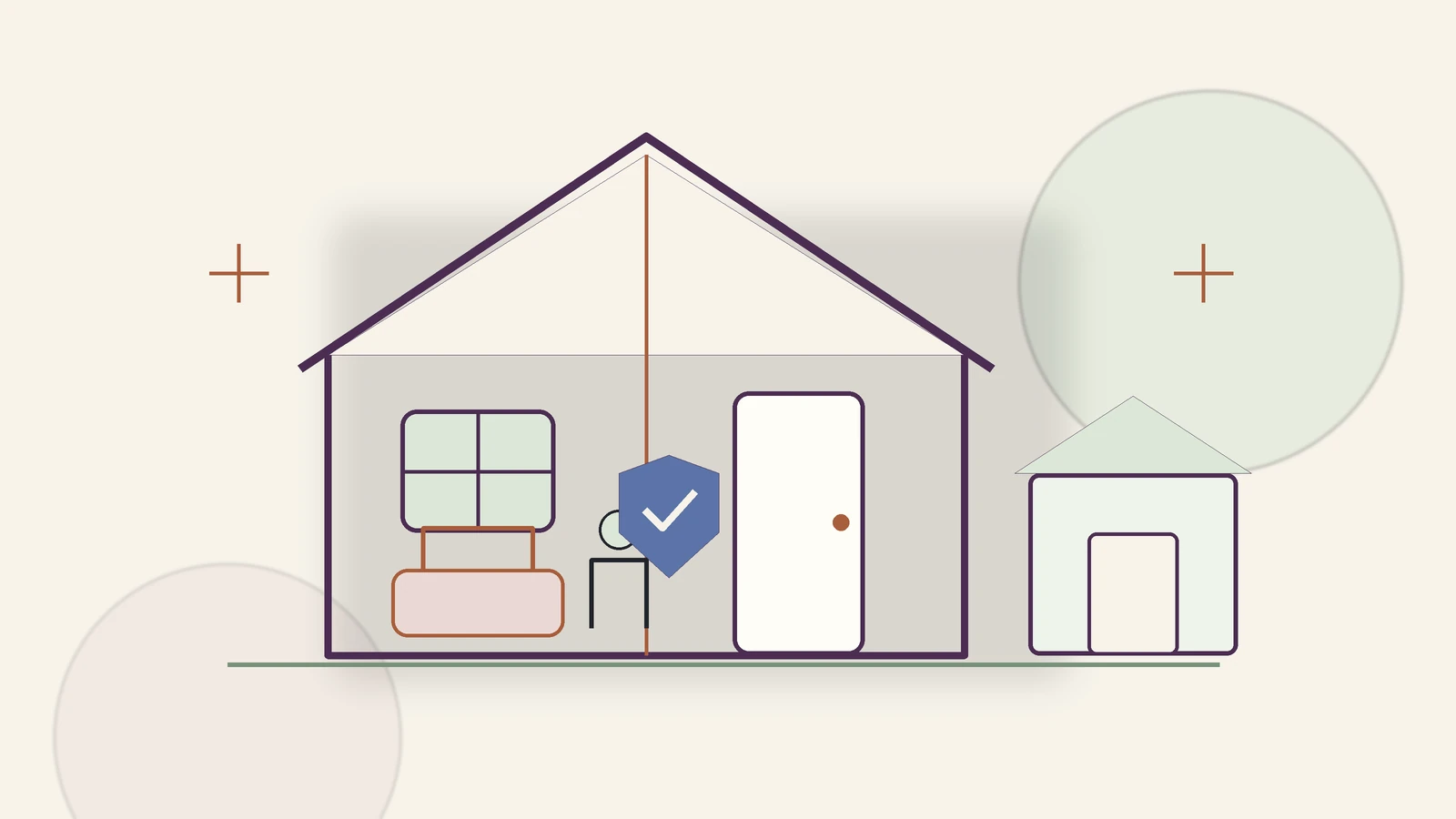
A standard homeowners insurance policy is not one coverage — it is a bundle of several coverages sold together. Most policies combine six parts: dwelling, other structures, personal property, loss of use, personal liability, and medical payments.
Each part answers a different question — what happens to my house, what happens to my stuff, and what happens if someone else is hurt or their property is damaged. Knowing what each one actually does is the fastest way to understand your own policy.
Key Takeaways
- A typical homeowners policy bundles six coverages: dwelling, other structures, personal property, loss of use, personal liability, and medical payments.
- Coverage only applies if the cause of loss (the “peril”) is one your policy includes — check which perils apply before assuming something is covered.
- Other Structures, Personal Property, and Loss of Use limits are commonly set as a percentage of your Dwelling limit, though the exact percentage is set by your own policy.
- Flood and earthquake damage are typically excluded from a standard homeowners policy and require separate coverage.
- Your declarations page is the fastest way to see your actual limits, deductibles, and whether replacement cost or actual cash value applies.
The six coverages, in plain English
Dwelling coverage
Dwelling coverage pays to repair or rebuild the structure of your home if it’s damaged by a covered peril, such as fire, wind, or hail. It also covers things permanently attached to the structure — built-in plumbing, wiring, and heating or cooling systems.
This is usually the largest single number on your policy, and it’s meant to reflect what it would cost to rebuild your home, not what your home would sell for on the real estate market. Those two numbers can be very different.
Other structures coverage
Other structures coverage pays for detached buildings on your property that aren’t attached to the main house — a detached garage, a shed, a fence, or a freestanding gazebo. It’s typically a set percentage of your dwelling limit, often illustrated around 10%, though your policy sets the actual figure.
Personal property coverage
Personal property coverage reimburses you for damaged, destroyed, or stolen belongings — furniture, electronics, clothing, and similar items. It generally follows you outside the home too, covering items in a storage unit or with a family member at college, subject to policy limits.
Certain categories — such as jewelry, firearms, cash, silverware, and some business property — may have special limits, sometimes only for particular causes of loss such as theft. Valuable items should be checked against the exact limits and endorsements in the policy rather than assumed to share the full Personal Property limit. For a practical way to document belongings and values, see how detailed a home inventory should be.
Loss of use coverage (additional living expenses)
If a covered loss makes your home temporarily unlivable, loss of use coverage helps pay the extra cost of living elsewhere — hotel bills, temporary rent, and similar expenses above what you’d normally spend. It does not pay for a loss that isn’t otherwise covered by your policy; if the cause of damage isn’t a covered peril, loss of use doesn’t apply either.
Personal liability coverage
Personal liability coverage protects you financially if you’re found legally responsible for someone else’s injury or property damage, and a claim or lawsuit results. It generally covers both the cost of your legal defense and any damages awarded, up to your policy limit.
This is a different question from “was my property damaged” — it’s about your legal responsibility to someone else, and it comes with its own set of exclusions and limits worth understanding on their own terms.
Medical payments to others
Medical payments coverage pays limited medical costs for someone accidentally hurt on your property (or by your pet), regardless of who was at fault. It’s separate from liability coverage, usually has a smaller limit, and typically doesn’t apply to injuries to you or people who live with you.
How coverage limits usually relate to each other
Many policies set Other Structures, Personal Property, and Loss of Use as a percentage of your Dwelling limit rather than as flat numbers you choose independently. The table below shows commonly used illustrative percentages — not a guarantee of what your policy uses.
| Coverage | Common illustrative basis |
|---|---|
| Dwelling | Amount you choose (should reflect rebuild cost) |
| Other Structures | Often around 10% of Dwelling limit |
| Personal Property | Often 50–70% of Dwelling limit |
| Loss of Use | Often 20–30% of Dwelling limit |
| Personal Liability | Amount you choose |
| Medical Payments | Amount you choose |
Your actual percentages and dollar limits are set by your specific policy. The reliable way to confirm them is to review your own insurance declarations page.
A fictional example, for illustration only
Consider a hypothetical homeowner, “Maria,” whose declarations page shows a $300,000 Dwelling limit. Her Other Structures coverage might show as $30,000 (10%), her Personal Property as $150,000 (50%), and her Loss of Use as $60,000 (20%). These numbers are entirely fictional and are shown only to illustrate how the percentage relationship commonly works — not to suggest any specific homeowner’s actual coverage.
What a standard policy typically does not cover
Two of the most common gaps are flood and earthquake damage. According to FEMA, most homeowners insurance does not cover flood damage, and flood coverage is generally sold as a separate policy, most often through the National Flood Insurance Program or a private flood insurer. Earthquake damage is also typically excluded from a standard homeowners policy and usually requires separate coverage or an endorsement.
Ordinary wear and tear, and maintenance-related problems like a slowly leaking roof you never repaired, are also generally outside what homeowners insurance is designed to cover — it responds to sudden, covered perils, not the routine cost of maintaining a home.
Policy-review checklist: what to check on your own policy
- What is my Dwelling limit, and does it reflect current rebuilding costs — not market value?
- What percentage or dollar amount applies to Other Structures, Personal Property, and Loss of Use?
- Are my Personal Liability and Medical Payments limits ones I actively chose, or default minimums?
- Does my policy pay Personal Property claims at actual cash value or replacement cost?
- Are there sub-limits on jewelry, art, electronics, or other valuables that might be lower than what I actually own?
- Is my home in an area where flood or earthquake coverage should be purchased separately?
Common misunderstandings
Misunderstanding: “My dwelling coverage is based on my home’s market value.”
More accurate: Dwelling coverage is meant to reflect the cost to rebuild the structure, which can be higher or lower than market value, since market value also reflects land and local real estate conditions.
Misunderstanding: “If my policy covers my house, it automatically covers floods too.”
More accurate: Flood damage is typically excluded from standard homeowners policies and needs separate flood insurance.
Misunderstanding: “Liability coverage and medical payments coverage are the same thing.”
More accurate: They’re different coverages with different purposes, different limits, and different fault requirements — liability generally requires a legal finding of responsibility, while medical payments typically pays regardless of fault, up to a smaller limit.
Important limitations
This article explains commonly used homeowners insurance coverage concepts for general education. It is not personalized insurance, legal, or financial advice, and it does not describe any specific insurance product. Coverage names, limits, percentages, exclusions, and endorsements vary by insurer, policy form, and state, and your own policy language controls what is and is not covered. Nothing here should be read as a promise that any particular loss will be covered, paid, or reimbursed.
FAQ
Is homeowners insurance required by law?
Homeowners insurance is generally not required by state law, but mortgage lenders commonly require it as a condition of the loan.
Does homeowners insurance cover my home business?
Typically not, or only in a limited way. Business-related liability and property are commonly excluded from a standard homeowners policy, and a separate business policy or endorsement is often needed.
What’s the difference between actual cash value and replacement cost for my belongings?
They’re two different ways of calculating a claim payment: actual cash value factors in depreciation for age and wear, while replacement cost generally does not. The difference can be significant, and it depends on which valuation method your specific policy uses.
Official sources
- NAIC — A Consumer’s Guide to Home Insurance
- NAIC — Insurance Topics: Homeowners Insurance
- NAIC — A Shopping Tool for Homeowners Insurance
- NAIC — Consumer Insight: My Insurance Doesn’t Cover What?
- Wisconsin Office of the Commissioner of Insurance — Consumer’s Guide to Homeowners Insurance (PI-015)
- FEMA — Flood Insurance
- National Flood Insurance Program — FloodSmart.gov
Conclusion
Homeowners insurance is easier to understand once you see it as six separate answers to six separate questions, rather than one single promise to “cover your house.” The fastest next step is to match these six coverages against your own declarations page and confirm your actual limits.
Once the coverage sections are clear, the next practical step is understanding which documents may be needed for an insurance claim.